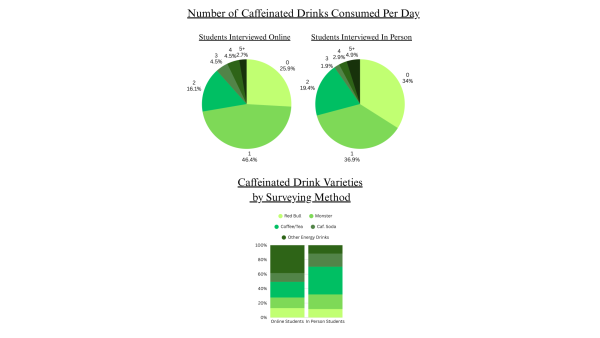
With finals rapidly approaching, I wanted to take a closer look at what gets many students through them: energy drinks—or more broadly—caffeinated drinks. I interviewed over 220 Topeka High students, using both online and in-person methods (with more than 100 students for each approach), about their consumption of caffeinated drinks. Metrics include the number of caffeinated drinks consumed per day and specific brands/types of caffeinated drinks consumed regularly by an individual.
Students interviewed in person were about 8% more likely than those interviewed online to claim that they consume absolutely no caffeinated drinks per day, and more strikingly, students interviewed in person were about 16% more likely to say that they drink coffee or tea daily than those interviewed online.
Here’s my theory: students lie in person. Perhaps the word “lie” is harsh; students don’t seem to be lying completely, but rather, bending the truth. I don’t think every student does this, but enough do that it shows up in the numbers. There is a general trend of students who are interviewed in person providing answers that seem healthier to them. As already noted, they’re more likely than students interviewed online to say that they consume natural drinks like teas and coffee, and they’re also more likely to say that they abstain from caffeinated drinks altogether.
I think this is because caffeinated drink consumption, and particularly, traditional energy drink consumption, is generally frowned upon. This makes admitting to drinking these beverages embarrassing to many, so naturally, when asked about their consumption, people might give low and/or healthy-seeming estimates.
The most important takeaway from this is that students understand how unhealthy caffeinated drinks can be, and that they simply don’t care. They wouldn’t answer with perceived-healthier alternatives if they didn’t think certain caffeinated drinks were unhealthy in the first place.
To understand what “healthy” constitutes when discussing caffeinated drinks, I talked to James Thayer, Associate Director of Fitness and Health Promotion at the Washburn University Student Recreation and Wellness Center.
“There’s a difference between perception and branding of health and what’s actually healthy,” Thayer said. He cited sugar, caffeine and additive vitamins and minerals as the main considerations when determining the healthiness of a caffeinated drink.
Sugar results in the increase of a drink’s calories, and it also makes the consumer more likely to “crash” from running out of energy quickly.
“Sugar isn’t bad, but its source is important,” Thayer said.
“Healthier sources have more vitamins and micronutrients.” Examples of healthy sugar sources include apples and sweet potatoes.
When asked about caffeine, Thayer was quick to mention that it doesn’t actually give energy. “Caffeine shifts our nervous system’s perspective on being tired,” Thayer said.
The FDA recommends no more than 100mg of caffeine per day for people under the age of 17, and no more than 400mg for those who are 18 and older. This means that most traditional energy drinks fall above the recommended level of caffeine for minors; for example, 12-ounce cans of Celsius, Alani and Red Bull all exceed 100 milligrams of caffeine, and a cup of coffee falls at the upper limit of the FDA’s recommendation.
There’s one thing about my survey that I didn’t mention: I gave students the option to tell me why they drink caffeinated drinks, and a stunningly high number of students cited carbonation and taste.
From a psychological perspective, this affection towards the taste and carbonation of certain caffeinated drinks may be related to their caffeine content and the good feelings that the brain associates with caffeine consumption.
“Individuals are very sensation-driven,” Thayer said. “Sensation-association isn’t healthy in the long term.”
Caffeine addiction is an often overlooked problem for students, and it stems from reliance on the aforementioned good sensations associated with caffeine.
Ironically, the more caffeine one consumes, the less effective it becomes. “If we’re constantly loading our arousal state, caffeine isn’t as effective,” Thayer said. “When, where, and how we use it [caffeine] should be very intentional.”
Looking towards finals from a health perspective, Thayer recommends prioritizing hydration and sleep, rather than late-night, insomnia-inducing studying. He also advises students to stay under their recommended levels of caffeine and sugar, and to be mindful of timing with respect to caffeine consumption.