“The Little White Bird, or Adventures in Kensington Gardens,” is a novel simultaneously sweet and sinister, comic yet deeply melancholic. It is, all together, a portrait of its creator, J.M. Barrie, and a portrait of London in 1902.
The story is not about Barrie (though it has more than a few hints of autobiography) it is about Captain W—— [as was fashionable at the time, nearly every surname within the novel is redacted], a forty-five-year-old retired military captain, who seems aloof and indifferent to the world; he is, after all, only a lonely old bachelor with a great dog. However, beneath his bristly, awkward exterior, there is a man who feels deeply, watching with sadness and snide remarks at people living the life that he wishes he could live.
That is when Mary A——, a little nursery governess, skips past his club-shop window. She is poor, and yet she is happily in love with a younger painter. These large displays of affection at first bother Captain W—— immensely, however when they suddenly stop, he realizes the great hole in his life that they filled.
He discovers that Mary A—— and the painter broke it off, but also discovers that Mary A—— and the painter each stare at their old meeting spot, an old mail box, waiting for the other to appear. So, Captain W—— deftly rams into the painter, discreetly dropping a letter and then watching things unfold. What follows is a reunion for the ages, woman and painter.
Captain W—— continues his anonymous kindnesses for Mary, watching from a far as she falls in love and marries the painter. There is something charming about Captain W—— pretending he does not care about Mary A—— while waxing poetic about her and clearly thinking a great deal more about her than he can admit.
The novel shows this dynamic as Captain W—— gently mocking, while clearly admiring, her class and fortitude as a thrifty yet poor woman. The novel continually returns to the poorest inhabitants of the city on the Thames, despite Captain W——’s seeming aloofness to their existence.
Captain W——, on a sub-textual level, wrestles with his own desire to be the Phileas Fogg type, the aloof man of some fortune, wanting nothing from life but a good waiter. However, he continually shows his admiration and desire to help those less fortunate than himself.
This class system would have seemed interesting and foreign to Barrie in 1902, being an outsider from Scotland, and became a common theme in many of his middle period works. Certainly his most well known work to critique the English-class system was “The Admirable Crichton,” a play from the same year. Within this work (and within “Dear Brutus,” and to a lesser extent “What Every Woman Knows”) Barrie presents the class-system as being ridiculous, while also being helpful and correct. These seem like contradictions, and indeed they are, however these contradictions reveal the absurdness of the entire idea of birth-rights.
The novel also presents low-class life with specificity and earnestness (which indeed may have stemmed from Barrie’s own awkward position as a man born of poverty but, by the end of his life, becoming rubbing elbows with the future Queen of England). Irene, a poor Londoner, is at first presented as a one dimensional street-Arab [a Victorian name for homeless children], however she is given tremendous depth, and we come to know nearly everything about her by the end of the book. She is also given a lovely passage within the novel, which was later echoed in 1915’s “A Kiss For Cinderella:”
“I believe I have surprised this little girl’s secret. She knows there are no fairy godmothers nowadays, but she hopes that if she is always true and faithful she may some day turn into a lady in word and deed, like… [Cinderella] whom she adores.
It is a dead secret, a Drury Lane child’s romance; but what an amount of heavy artillery will be brought to bear against it in this sad London of ours. Not much chance for her, I suppose.
Good luck to you, Irene.” — Chapter XII, The Pleasantest Club in London
Captain W—— discovers that Mary and the painter are expecting a baby: Captain W—— assumes that Mary wants a girl. Thus, when Mary’s husband stands outside of the delivery room and Captain W—— approaches, he asks about a girl. But Mary is having a boy, the hitherto mentioned David.
The novel at times veers into a collection of personal essays, and one of the great subjects is the difference between women and men, and the more-muddled reality. The novel simultaneously affirms and denies Edwardian society’s views of gender. In the Edwardian period gender was more fluid than it is often given credit for, and we see this fluidity in the character of Captain W——. He exists primarily in his performance of masculine military-stoicism, a state of mind which is not natural to him but he inhabits to protect himself.
Throughout, he identifies with women and uses feminine labels; For instance, he is not called a bachelor in the club, but a spinster (an unmarried, childless woman). Many poetically vague passages seem to imply a non-conforming identity:
“I am tolerably kind, I believe, and most inoffensive, a gentleman, I trust, even in the eyes of the ladies who smile at me as we converse… Ah, ladies, I forget when I first began to notice that smile and to be made uneasy by it. I think I understand it now, and in some vague way it hurts me…. You will scarcely credit it, but I have just remembered that I once had a fascinating smile of my own. What has become of my smile? I swear I have not noticed that it was gone till now; I am like one who revisiting his school feels suddenly for his old knife. I first heard of my smile from another boy, whose sisters had considered all the smiles they knew and placed mine on top. My friend was scornful, and I bribed him to mention the plebiscite to no one, but secretly I was elated and amazed. I feel lost to-night without my smiles. I rose a moment ago to look for it in my mirror.” — Chapter IX, A Confirmed Spinster
Still, however, the greatest tragedy within Captain W——’s life is the loss of a woman. They planned a life together; their greatest plan was for a boy called Timothy. Captain W—— always wanted to be a father. However, when he fell out of love with this woman, he closed his heart to anyone. Thus, no child, but a St. Bernard dog.
This does not stop Captain W—— from visiting the painter. Through these visits he discovers that Mary A—— is searching for him, because of his earlier good deeds. Throughout their conversation, the painter assumes that Captain W—— is another father, waiting for the go-ahead to see his babe, and Captain W—— does not contradict this; he tells the painter that his son is a boy called Timothy.
At last, Mary A—— discovers who her anonymous samaritan is, and she sends an invitation to Captain W—— to tea. He refuses, and decides then that he will never speak to her.
But, Captain W—— does begin seeing Mary A——’s son David, walking him in the Kensington Gardens. Captain W—— is at first confused by the child, but his heart quickly melts, and as David slowly grows from a babe to a boy, Captain W—— spends almost every day with him in the gardens.
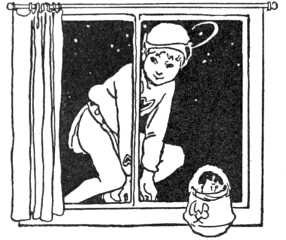
It is there that Captain W—— begins to tell David stories, stories of his life before and stories of the magical Kensington Gardens.
The novel, then, has thus far been a story Captain W—— was telling to David in the gardens, and for six chapters more it is a fantastic story told to David in the Gardens: the origin of Peter Pan. These chapters are very melancholic and beautiful in their own way, and they create a marvelous texture when set against the rest of the novel, and they serve as an intermission.
They also carry over many of the themes present within Captain W——’s story; just like Peter Pan, Captain W—— is alone in the world, a “betwixt-and-between” with no family. As soon as he finds a family in the person of Maimie Mannering, she leaves him.
And just like Captain W—— he silently performs his kindness, burying the children who die during the night in the Kensington Gardens, all the while wishing he could just play with them.
The book is short, each chapter is only seven or so pages, and yet within the volume there is a simultaneous depth and breadth of content. On some days, one notices the gentle comedy and biting satire, on others the melancholic tragedy at the heart of the stories, but the best days are the ones where all of it can be appreciated.
Captain W—— soon begins to see David as a son, and revels in pretending to be father. For the first time he is happy, crystallized in his first experience putting David to bed. He is so excited to do every little homely thing that any other father would think a chore to do, because knowing life without a child, he can appreciate it more.
“We were to do all the important things precisely as they are done every evening at his own home, and so I am in a puzzle to know how it was such an adventure to David. But I have now said enough to show you what an adventure it was to me… At twenty-five past six I turned on the hot water in the bath… I then said, ‘Half-past six; time for little boys to be in bed.’ I said it in the matter-of-fact voice of one made free of the company of parents, as if I had said it often before, and would have to say it often again, and as if there was nothing particularly delicious to me in hearing myself say it. I tried to say it in that way…
Then I placed my hand carelessly on his shoulder, like one a trifle bored by the dull routine of putting my little boys to bed, and conducted him to the night nursery, which had lately been my private chamber. … With an indescribable emotion, I produced a night-light from my pocket and planted it in a saucer on the wash-stand.” – Chapter XIX, an Interloper
It is then that he decides that he wants David for his own. He becomes, in this moment, as the Lost Boys in the Home Under the Ground, threatening Wendy, telling her she cannot go on and have a life beyond them.
Unlike the Lost Boys, who have Tootles to remind them of good form, Captain W—— has nothing but himself, and the mounting realization that David will grow up and move beyond him, whether he wants him to or not.
“David is not my boy, and he will forget. But Timothy would have remembered.” – Chapter XXIII. Pilkington’s
David tells Captain W—— this is not true, but Captain W—— can already see it. David begins to grow more distant, more active with his own friends, he no longer believes in Peter Pan or the bird-island on the Serpentine.
Later Captain W—— finds out Mary A—— is writing a novel, called “The Little White Bird,” and he decides immediately it is a trifle about the daughter she could never have. After all, the little white birds are the babies that never found a mother.
One of the last times that David and Captain W—— meet, David reveals that Mary A—— has a daughter called Barbara on the way, and so has set aside writing “The Little White Bird.” Upon hearing this, Captain W—— decides to compose his own version of “The Little White Bird,” so that he can send her the manuscript and lord over her that he wrote something she never could.
This is the final time that we see his cruelty come through. This cruelty may seem bitter from the synopsis, however it never feels real within the text; it is as if Captain W—— is winking at us, asking us to go along with his fantasies, and we cannot help but oblige. The bitterness anyhow is a great draught, preventing the book from becoming too sweet or sentimental, words which are not on their own negatives.
The novel ends with Captain W—— finally meeting Mary A—— and presenting his manuscript to her. They discuss his novel, and she tells him that she was not writing “The Little White Bird” for her own woes, but for Captain W——’s.
As in the 1908 play “What Every Woman Knows,” Barrie possesses a proto-feminist view of women as more perceptive than men, and the direct cause of every man’s success. Throughout the novel, Captain W—— has assumed nearly everything about Mary’s personal life without ever once speaking to her; in his first conversation with her, he discovers that everything he thought about her is completely incorrect. But importantly, everything she thought of him is proved correct.
She invites him to tea with her woman friends. Once more, Captain W—— shares company with women instead of men.
This is what Captain W—— has been wishing for all the while, though he could never admit it, so at first he acts aloof. But in the end, he reveals his true happiness, and through that gets his happy ending.
“‘In twenty years,’ I said, smiling at her tears, ‘a man grows humble, Mary. I have stored within me a great fund of affection, with nobody to give it to, and I swear to you, on the word of a soldier, that if there is one of those ladies who can be got to care for me I shall be very proud.’ Despite her semblance of delight I knew that she was wondering at me, and I wondered at myself, but it was true.” — Chapter XXVI, A Dedication
Throughout the novel, Captain W—— has been an unwilling Father Christmas, giving physical things so that he does not need give his soul. But when he at last gives his soul, in the form of “The Little White Bird,” he is not met with vitriol but with kindness, and a gentle friend.
This novel is so deft, so wonderfully ambiguous. J.M. Barrie is a master of style, and we see that clearly with each word. There are funny observances, which are made funny not by what is happening, but in how it happens; the same can be said of tragedy, which is made more tragic by the words used.
“The Little White Bird” is one of those novels which rewards its readers with diamonds, jewels of observation; it is gentle and biting, melancholic and comic. It is a look at one life, one brain, and for that it is the greatest treasure of all.